Years ago, I was sitting at Carol’s house with Danielle, eating a dish of roasted potatoes with a crispy crust, soft inside, and cottage cheese. There may have been a few other things mixed in, too, we honestly can’t remember (but boy was it good). It sounded a little like the French dish pommes Anna, though it wasn’t trying to be fancy. It was simply delicious, honestly a little out-of-body in how good it was.
When we asked Carol for the recipe, she just laughed, and gave us an amused grin, before proceeding to tell us the dish's origins. When Carol was younger she worked at her dad’s family restaurant, the chef would sometimes overorder ingredients like cottage cheese, and Carol was the one tasked with pulling together dishes to use them up before they went bad.
It was clear Carol loved that restaurant, and even more obvious how well she knew her way around the kitchen. Her family’s restaurant sounded lively and a little chaotic. But most of all it was clearly a place that gave her plenty of opportunities to be creative.
What a Dish Taught Me About Making
That dish has stuck with us because it captures how we learned to approach things at Turk Hill. Marc and Carol had a way of looking at materials and situations differently to see how they could be used and make the most impact. And nobody I know saw this better than Danielle, who spent many years working alongside the duo as a studio manager and instructor.
“We didn’t always solve a neat problem, yet at the end of the day we always made something unique, something sellable,” she tells me, laughing and retelling a story of how she helped them make art to sell at an upcoming art festival by gluing bits and bobs stored around the studio to a metal rod—bits and bobs that had already served a purpose and were sitting in storage. Carol rummaged around, pulled out this and that, and next thing you know she had something that would sell. “I’m pretty sure they sold out of those in like one day,” Danielle adds, again with a laugh.
Nothing you start with has to be perfect. It’s about iterations, accepting things as they are, and putting them in places where they work. “Parts are parts,” she continues, adding, “So often, people get stuck waiting to get it right on the first try or waiting for the ideal materials to make art.”
Working at Turk Hill we learned it's really about having the components to play with, yes, even scrappy ones. Sometimes you just need something as a placeholder, and sometimes that placeholder ends up being the spark you needed to open up a whole new world of ideas.
Creativity can come in how you use the parts. Art doesn’t have to be pristine, it’s not perfect. When you look at things as possibilities: it opens up more possibilities for you.
Making the Space Part of the Art
That same approach shaped our studio itself. When we moved into our original studio space Richard Aerni had left behind shelving, lumber, and odds and ends that we repurposed over and over for work tables, wedging tables, and tool racks.
“To me, our studio is one of my biggest art pieces to date,” says Danielle, adding, “Making pots isn’t so far away from creating a studio space, the tables, and the tools needed to make pottery. Having that close relationship with the space makes the studio feel alive and intentional.”
Why Potatoes Annie Ceramic Arts Gallery?
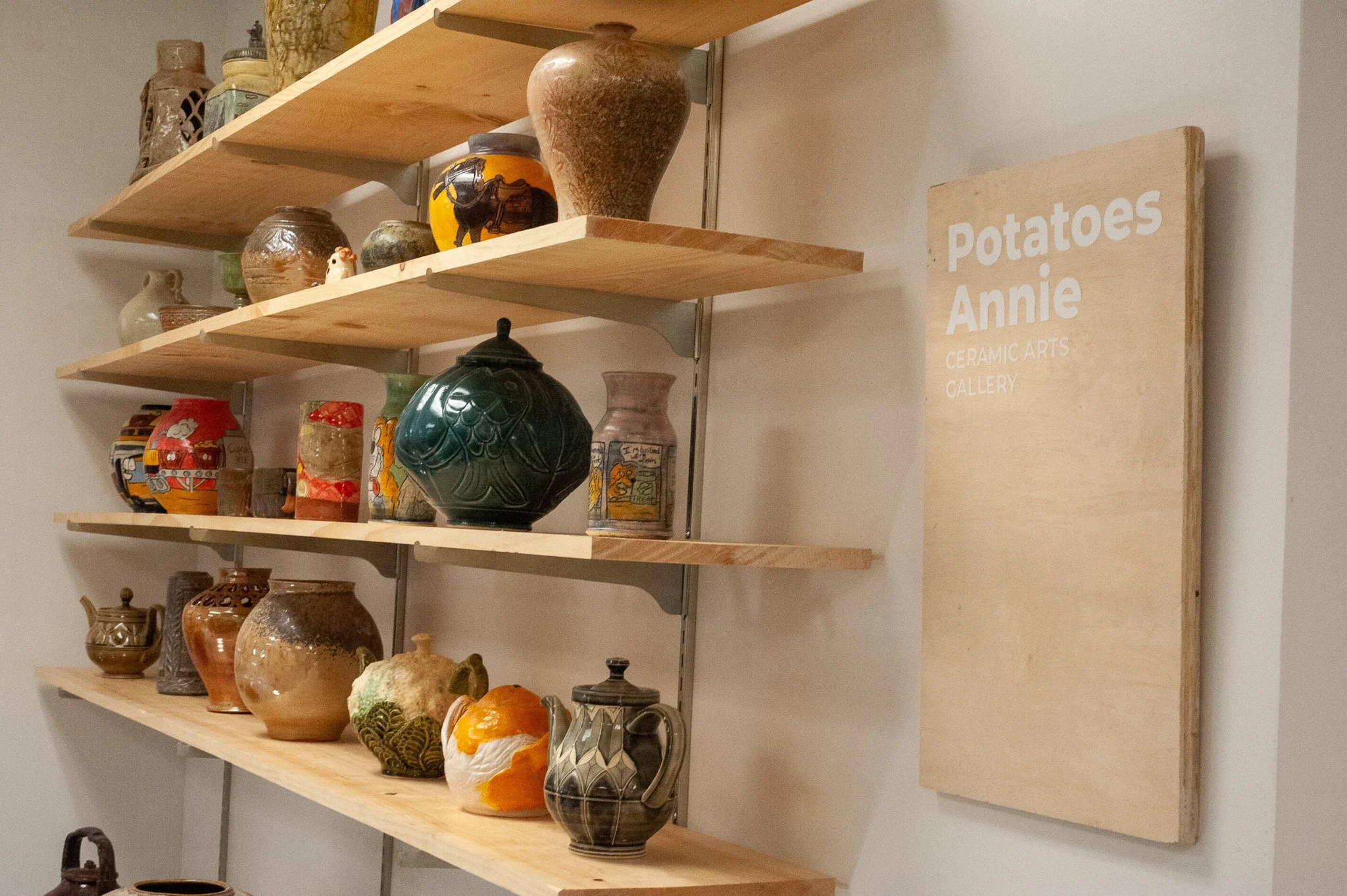
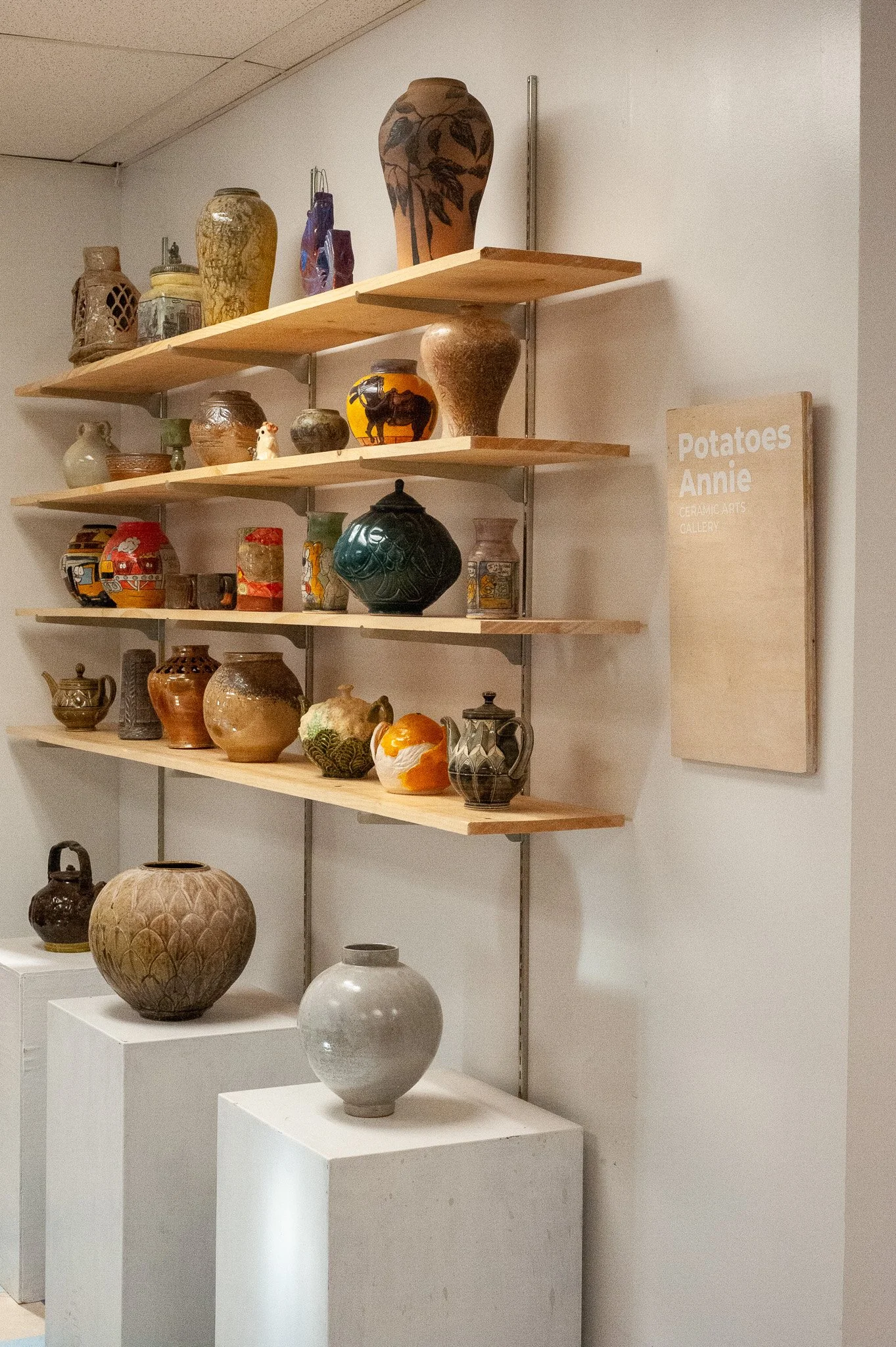
Naming the gallery Potatoes Annie Ceramic Arts Gallery is about making something extraordinary out of what you already have. It reflects what we learned from Carol and Marc at Turk Hill: working with what’s in front of you, carrying forward lessons from the past, and not feeling like you have to run out for every exact thing you think you need.
More than anything, we want to share that mindset with our club and pottery studio members. Things don’t need to be perfect. Go with the flow, trust the process, riff off the classics. Perfect isn’t interesting. Being engaged, immersed, and present is what making pottery is really all about.
“I see this gallery as a way to spark conversation and inspiration right inside our studio,” she continued. “It’s a jumping-off point where people can see what’s possible, look at work from other students, renters, and local artists, and get inspired.” And for both of us, it’s a tool to show our community that what one person overlooks or dislikes might be the exact thing someone else loves about a piece.
As I worked to wrap up this blog post, I asked Danielle why she felt Potatoes Annie was the right name for our gallery, and she responded, “I’m thankful for the relationship I have with Carol and Marc—there’s a real magic in the way they turn humble beginnings into something special. It’s an incredible concept, Potatoes Annie was an incredible dish, and honestly, it all just feels like magic.”
Carol and Marc both work so hard every day to make something meaningful, both at Turk Hill Craft school, and in their individual endeavors., Together they’ve built a pretty remarkable community, and both Danielle and I are proud to have a lineage that starts with them.
“They changed my life in ways I didn’t see coming, and I didn’t really know what was possible until I started working with them.” Smiling, before walking off to improvise her own thanksgiving dinner dish.
Thank you for reading! If you are interested in learning more about the Gallery, or Wheel & Slab, please message us to schedule a visit, or stop by during one of our open studio sessions. Come take a look, bring your curiosity, and see what happens when you work with what you have!